
Avenida Central, in Braga
The Congregados Basilica is located on Avenida Central, city of Braga, northern Portugal. This 18th century religious temple is known as the Convent, College and Church of the Congregates, and as the Congregation of S. Filipe Néri.
Construction
During this period of remodeling of the Congregation, the church also became a reality built precisely on the site where the Oratory previously stood.
The works began in 1703, by Manuel Fernandes da Silva, and were completed by the architect André Soares at the beginning of the second half of the 18th century.
This temple demonstrates a certain interior and exterior monumentality as required by the Congregation.
The ordination took place in 1717, after the chancel and part of the nave, up to the pulpit, were completed. The Church is dedicated to Our Lady of the Assumption.
The works began in 1703, by Manuel Fernandes da Silva, and were completed by the architect André Soares at the beginning of the second half of the 18th century.
This temple demonstrates a certain interior and exterior monumentality as required by the Congregation.
The ordination took place in 1717, after the chancel and part of the nave, up to the pulpit, were completed. The Church is dedicated to Our Lady of the Assumption.
Renovations
At the end of the 19th century, several works were carried out in the church, which included gilding the altars and restoring the roofs and the sacristy, and these works were paid for by donations left in the will of João Ferro de Lima, in addition to other various works.
The statues of S. Filipe Néri and S. Martinho de Dume were placed in 1964.
The statues of S. Filipe Néri and S. Martinho de Dume were placed in 1964.
Facade
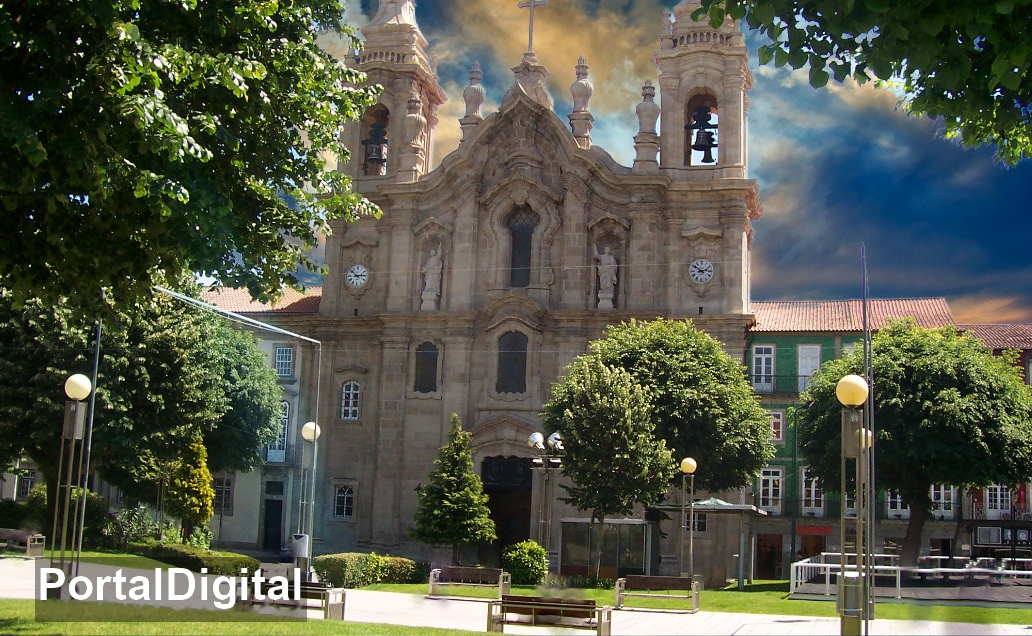
The central façade, built between 1761 and 1766 by the Galician master bricklayer Paulo Vidal, is marked by its accentuated verticalism and delimited by pilasters. The pilasters are defined as thick stonework frames, highlighting the central part.
The facade was not finished at this time, with the dome still missing from one of the towers and the upper half from the other. The facade is torn by the main portal with a cut-out frame and topped by a large window also with a cut-out frame, flanked by two other smaller windows with the same frame.
There is a large central window that resembles a lock with a three-lobed finish and is flanked by two niches with images of Saint Philip Neri and Saint Martin de Dume.
The facade was not finished at this time, with the dome still missing from one of the towers and the upper half from the other. The facade is torn by the main portal with a cut-out frame and topped by a large window also with a cut-out frame, flanked by two other smaller windows with the same frame.
There is a large central window that resembles a lock with a three-lobed finish and is flanked by two niches with images of Saint Philip Neri and Saint Martin de Dume.
Bell Towers
The church develops longitudinally, with a rectangular plan consisting of a single nave, chancel, bell towers and the convent on the side.
The side towers were not completed due to the Oratorian Friars being forced to leave Portugal.
The east tower was standing, although not finished, and the roof and dome were missing, and the west tower was no more than half built.
In 1888, a clock was installed in the east tower, the one on the left, and it was only in 1958 that the towers were completed, with the help of António Augusto Nogueira da Silva.
The bells and clock in the west tower were placed in 1960 and the mechanism for ringing the bells and the electrical control of the clocks were placed in 1963.
The side towers were not completed due to the Oratorian Friars being forced to leave Portugal.
The east tower was standing, although not finished, and the roof and dome were missing, and the west tower was no more than half built.
In 1888, a clock was installed in the east tower, the one on the left, and it was only in 1958 that the towers were completed, with the help of António Augusto Nogueira da Silva.
The bells and clock in the west tower were placed in 1960 and the mechanism for ringing the bells and the electrical control of the clocks were placed in 1963.
Chancel
The main chapel is on a higher level of the nave, with a barrel vault roof, plastered and painted.
The neoclassical main altarpiece, dated 1781, is in polychrome gilded carving with blue green and pink marbles with thick fluted columns and on the pediment we see an angel on each side.
Flanking the triumphal arch are four granite statues: Abraham, Isaac, Jacob and David.
In the center, a shield alludes to Our Lady of the Assumption, the patron saint of the Church.
The neoclassical main altarpiece, dated 1781, is in polychrome gilded carving with blue green and pink marbles with thick fluted columns and on the pediment we see an angel on each side.
Flanking the triumphal arch are four granite statues: Abraham, Isaac, Jacob and David.
In the center, a shield alludes to Our Lady of the Assumption, the patron saint of the Church.
Interior
The nave has a false barrel-vaulted roof lined with cork and a high choir above a depressed arch.
The pipe organ is decorated in gilded and polychrome carvings, but on a small side balcony.
The organ was restored in 1995 at the expense of benefactor Teotónio Luiz Pereira Andrade dos Santos.
The nave is flanked by eight side altars in a perfect arch resting on Tuscan pilasters with gilt and white carved altarpieces.
The altar of Santo António is considered a Johannine baroque of great quality, according to Eduardo Pires de Oliveira. The remaining altars contain altarpieces in the Rococo style.
The pipe organ is decorated in gilded and polychrome carvings, but on a small side balcony.
The organ was restored in 1995 at the expense of benefactor Teotónio Luiz Pereira Andrade dos Santos.
The nave is flanked by eight side altars in a perfect arch resting on Tuscan pilasters with gilt and white carved altarpieces.
The altar of Santo António is considered a Johannine baroque of great quality, according to Eduardo Pires de Oliveira. The remaining altars contain altarpieces in the Rococo style.
Chapel of Our Lady of Aparecida
Also the work of André Soares, the chapel-oratory of Nossa Senhora da Aparecida or the Monks in one of the church's dependencies has a Greek cross structure.
The highlight is the vault with an elliptical section and lantern top and the gilded altarpiece dating from the 1760s.
The highlight is the vault with an elliptical section and lantern top and the gilded altarpiece dating from the 1760s.
Use of the Convent
With the extinction of the Religious Orders, in 1834, the Oratorians had to leave Braga.
Thus, his assets, which included the Church, passed to the State.
The conventual part had various purposes over the centuries and served as the Public Library, the Braga High School, the Minho Brigade Headquarters and a temporary infirmary during the cholera period.
It also had a role as a public department, for Finance and Civil Government, and the Primary Ministry of Braga and ended with the Integrated Teacher Training Center of the University of Minho.
Thus, his assets, which included the Church, passed to the State.
The conventual part had various purposes over the centuries and served as the Public Library, the Braga High School, the Minho Brigade Headquarters and a temporary infirmary during the cholera period.
It also had a role as a public department, for Finance and Civil Government, and the Primary Ministry of Braga and ended with the Integrated Teacher Training Center of the University of Minho.
Classification
On March 15, 1975, the Holy See granted the Church of the Congregates the title of Minor Basilica. It has been classified as a Property of Public Interest since 1993.