
Monte de Santa Margarida, in Braga
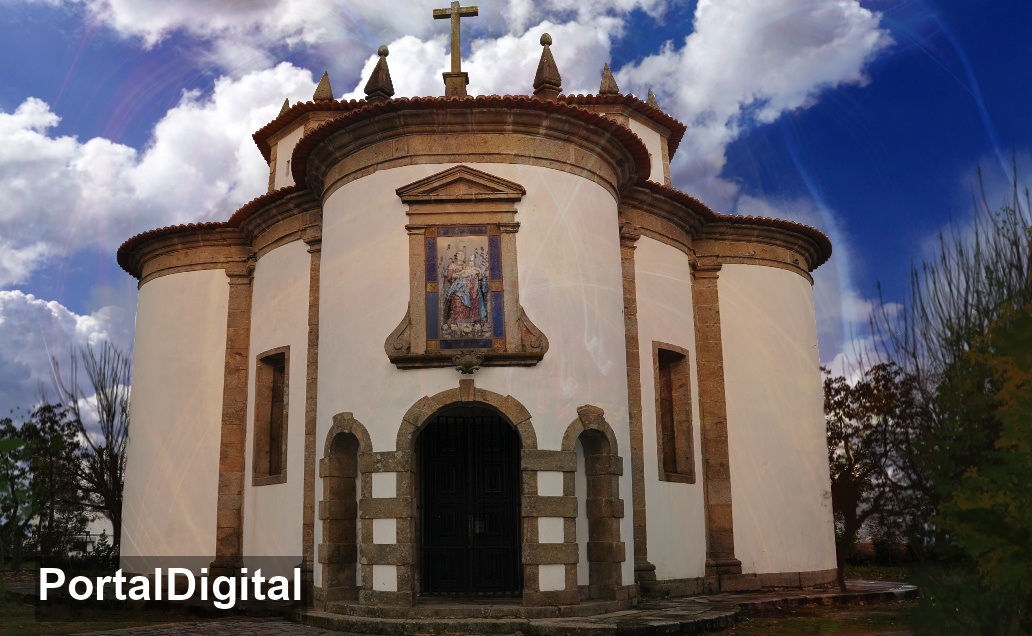
The chapel of Nossa Senhora de Guadalupe is located in the parish of S. Victor, on Monte de Santa Margarida, Rua da Regueira, in Braga, northern Portugal.
It is thought that in previous times it was a temple invoking Saint Margaret and that, at the beginning of the 18th century, it was completely replaced by another, and ordered to be built by the confraternity of Our Lady of Guadalupe, with strong monetary support from Archbishop D. Rodrigo de Moura Teles, who blessed it on March 23, 1725.
It is thought that in previous times it was a temple invoking Saint Margaret and that, at the beginning of the 18th century, it was completely replaced by another, and ordered to be built by the confraternity of Our Lady of Guadalupe, with strong monetary support from Archbishop D. Rodrigo de Moura Teles, who blessed it on March 23, 1725.
Construction
What most differentiates the Guadalupe chapel, in addition to its privileged location, perched on top of a small elevation, is its unusual architecture. Despite the centralized plan, like many other churches in Braga, its circular shape is unique in the city. The construction of the Chapel, in 1719, was carried out by master bricklayer Manuel Fernandes da Silva.
Facade
This building denotes mastery both in the curvilinear forms of its exterior, as well as in the simplicity of the interior and in the expertise of André Soares in the execution of the main altarpiece designed in the rococo style.
The Guadalupe chapel has a centered plan, with a main chapel and two sides, and is oriented to the southwest. This building displays an exonarthex and two semicircular side chapels.
The outer rectangular body of the chapel encompasses the main chapel, the sacristy and the Brotherhood room. The facades are plastered and painted in white and contain a base, with Tuscan pilasters at the corners and pillared corners.
The main facade is composed of an exonarthex with three perfect arched bays, with a masonry frame. The central arch is the widest and has a rectangular niche with a protruding sill. The sill displays, in the center, a granite cartouche, with the inscription translated as: “PROTEGAM VRBEM ISTAM 1747”. The niche's frame is flanked by pilasters with fins and is topped with a triangular pediment.
Outside there is a paved churchyard, which breaks away from the green space of lime trees. This park is very calm and you feel great peace, despite the proximity to the hustle and bustle of the urban center. The entrance is via a granite staircase with two levels.
The Guadalupe chapel has a centered plan, with a main chapel and two sides, and is oriented to the southwest. This building displays an exonarthex and two semicircular side chapels.
The outer rectangular body of the chapel encompasses the main chapel, the sacristy and the Brotherhood room. The facades are plastered and painted in white and contain a base, with Tuscan pilasters at the corners and pillared corners.
The main facade is composed of an exonarthex with three perfect arched bays, with a masonry frame. The central arch is the widest and has a rectangular niche with a protruding sill. The sill displays, in the center, a granite cartouche, with the inscription translated as: “PROTEGAM VRBEM ISTAM 1747”. The niche's frame is flanked by pilasters with fins and is topped with a triangular pediment.
Outside there is a paved churchyard, which breaks away from the green space of lime trees. This park is very calm and you feel great peace, despite the proximity to the hustle and bustle of the urban center. The entrance is via a granite staircase with two levels.
Interior
Inside is the image of Our Lady of Guadalupe protected by glass. At the top there are pinnacles and a masonry cross. This upper part is marked by a game of volumes, where the highest nave stands out.
The interior of the chapel is plastered and painted, with parquet flooring in the nave and stone in the side chapels. The nave is covered by a dome with masonry sections, decorated with volutes. From its center descends a huge, sack-shaped chandelier. The side chapels are covered with plastered barrel vaults and painted white.
In the chancel there is the beautiful altarpiece by André Soares, in rococo style, which features carved and polychromatic work, in shades of blue, white, green and gold.
In the side chapel, on the Epistle side, there is a straight plan altarpiece, where there is a sculpture of S. Marçal (protector of firefighters); On the opposite side, in the nave on the Gospel side, the altarpiece of N.ª Sr.ª da Piedade, also with a straight plan, carved, polychrome and adorned with decorative motifs in gold.
On the right corbel of the San Marçal altarpiece, there is a graceful sculpture of Saint Anne teaching the Virgin Mary, as a girl, to read.
The interior of the chapel is plastered and painted, with parquet flooring in the nave and stone in the side chapels. The nave is covered by a dome with masonry sections, decorated with volutes. From its center descends a huge, sack-shaped chandelier. The side chapels are covered with plastered barrel vaults and painted white.
In the chancel there is the beautiful altarpiece by André Soares, in rococo style, which features carved and polychromatic work, in shades of blue, white, green and gold.
In the side chapel, on the Epistle side, there is a straight plan altarpiece, where there is a sculpture of S. Marçal (protector of firefighters); On the opposite side, in the nave on the Gospel side, the altarpiece of N.ª Sr.ª da Piedade, also with a straight plan, carved, polychrome and adorned with decorative motifs in gold.
On the right corbel of the San Marçal altarpiece, there is a graceful sculpture of Saint Anne teaching the Virgin Mary, as a girl, to read.