
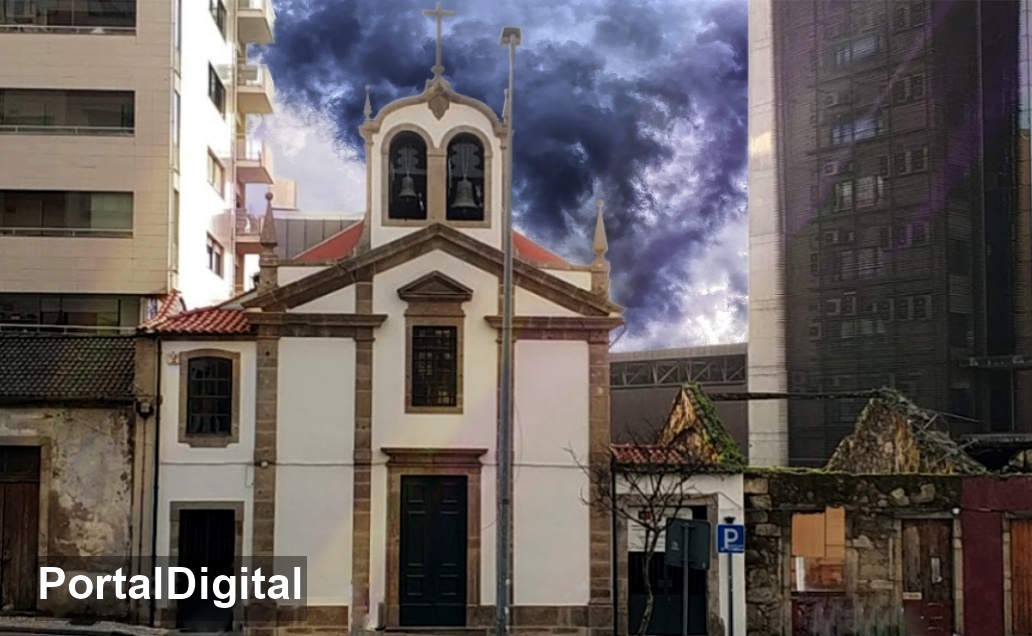
Rua Cardoso Avelino, in Braga
The Chapel of São Miguel-o-Angel is located on Rua Cardoso Avelino, parish of Maximinos, City of Braga, Northern Portugal.
This Chapel has a religious architecture in the Rococo and revivalist style, a longitudinal plan with a single nave, chancel and L-shaped body, laterally added, integrating the sacristy and hall.
The chapel built at the end of the century. 19 presents a main facade in a Mannerist style inspired by the Jesuit church of São Paulo, with a set of pilasters and topped by a pediment interrupted at the base by a large window, and with a bell crowning the neo-baroque gable.
The interior, with its nave and main chapel covered by a stuccoed barrel vault, houses all the contents from the original chapel, consisting of pelmets, pulpits and rococo altarpieces, richly decorated with acanthus and shells.
This Chapel has a religious architecture in the Rococo and revivalist style, a longitudinal plan with a single nave, chancel and L-shaped body, laterally added, integrating the sacristy and hall.
The chapel built at the end of the century. 19 presents a main facade in a Mannerist style inspired by the Jesuit church of São Paulo, with a set of pilasters and topped by a pediment interrupted at the base by a large window, and with a bell crowning the neo-baroque gable.
The interior, with its nave and main chapel covered by a stuccoed barrel vault, houses all the contents from the original chapel, consisting of pelmets, pulpits and rococo altarpieces, richly decorated with acanthus and shells.
Construction
This Chapel was originally built at the beginning of the 18th century in the Carvalheiras area, close to the Cathedral of Braga, and was the place where the archbishops covered themselves with vestments to make their solemn entry into the Cathedral.
At the beginning of the 19th century, with the appearance of new streets, the chapel was located at a crossroads, and the idea of relocating it to the Cruz de Pedra neighborhood, close to the Railway Station, arose.
The city was rapidly developing for this area, and a church was needed near the train station where travelers could pray and ask for protection during their journeys.
The chapel was built at the end of the 19th century and has a neo-modernist main façade with a set of pilasters topped by a pediment interrupted at the base by a large window, and with a bell crowning the gable (side walls of a building without openings) with a neo-baroque design.
On January 29, 1744, the Confraternity of São Miguel-o-Anjo, through the reverend Francisco Delgado, handed over the execution of the stone work on the body of the chapel to Domingos Martins, master-bricklayer on Rua da Cónega, in the city of Braga, who committed to following the notes provided, and to completing the work within 3 months.
The Judge of the Brotherhood of Nossa Senhora do Ó and São Miguel, Francisco de Araújo, hired master bricklayer João Gonçalves Ribeiro, resident in Cruz de Pedra, Braga, to enlarge the main chapel.
On March 24, 1756, the Brotherhood of Nossa Senhora do Ó and São Miguel hired the master bricklayer João Gracias, a Galician assistant in Braga, to build the sacristy and house of the Brotherhood's Table in the form of the plan and notes provided in the second half of the 18th century, and execution of the altarpieces, possibly according to the design of André Soares.
In the construction of this temple we can observe the existence of decorative elements, holy water fonts, base of the pulpit and lavatory of the sacristy in granite, doors, windows, balustrade dormer of the high choir, wind guard, pulpit guard, altarpieces, pelmets, wooden floors and interior staircase, stucco ceilings, iron window grilles, external covering in flap and straw tiles.
The lateral altarpieces are identical, with only the difference in the tribune, and have a straight plan with a single axis framed by volutes and topped with a scalloped cornice.
The tribunes with decoration on the upper level of acanthus, the Sagrada Família Altarpiece with a tribune divided into two in the upper half with the imaginary, and in the lower half with the embedded tabernacle.
The Tribune of the altarpiece of Nossa Senhora das Graças with a dolly topped by a pedestal or small pedestal with a round or square base, which serves as a support with an image of the patron saint São Miguel and the urn-shaped altar.
At the beginning of the 19th century, with the appearance of new streets, the chapel was located at a crossroads, and the idea of relocating it to the Cruz de Pedra neighborhood, close to the Railway Station, arose.
The city was rapidly developing for this area, and a church was needed near the train station where travelers could pray and ask for protection during their journeys.
The chapel was built at the end of the 19th century and has a neo-modernist main façade with a set of pilasters topped by a pediment interrupted at the base by a large window, and with a bell crowning the gable (side walls of a building without openings) with a neo-baroque design.
On January 29, 1744, the Confraternity of São Miguel-o-Anjo, through the reverend Francisco Delgado, handed over the execution of the stone work on the body of the chapel to Domingos Martins, master-bricklayer on Rua da Cónega, in the city of Braga, who committed to following the notes provided, and to completing the work within 3 months.
The Judge of the Brotherhood of Nossa Senhora do Ó and São Miguel, Francisco de Araújo, hired master bricklayer João Gonçalves Ribeiro, resident in Cruz de Pedra, Braga, to enlarge the main chapel.
On March 24, 1756, the Brotherhood of Nossa Senhora do Ó and São Miguel hired the master bricklayer João Gracias, a Galician assistant in Braga, to build the sacristy and house of the Brotherhood's Table in the form of the plan and notes provided in the second half of the 18th century, and execution of the altarpieces, possibly according to the design of André Soares.
In the construction of this temple we can observe the existence of decorative elements, holy water fonts, base of the pulpit and lavatory of the sacristy in granite, doors, windows, balustrade dormer of the high choir, wind guard, pulpit guard, altarpieces, pelmets, wooden floors and interior staircase, stucco ceilings, iron window grilles, external covering in flap and straw tiles.
The lateral altarpieces are identical, with only the difference in the tribune, and have a straight plan with a single axis framed by volutes and topped with a scalloped cornice.
The tribunes with decoration on the upper level of acanthus, the Sagrada Família Altarpiece with a tribune divided into two in the upper half with the imaginary, and in the lower half with the embedded tabernacle.
The Tribune of the altarpiece of Nossa Senhora das Graças with a dolly topped by a pedestal or small pedestal with a round or square base, which serves as a support with an image of the patron saint São Miguel and the urn-shaped altar.
Renovations
In December 1879, due to the widening of Rua da Sé affecting its chapel, the Board of the Brotherhood of São Miguel-o-Anjo appointed a Commission to deal with the adjustment of the expropriation of the chapel and seek to remove it.
In November 1880, the project to rebuild the chapel was designed by the sculptor João Baptista Braga, and in May 1881 the location of the future chapel was decided, which will be close to the Railway station.
In July 1882, the removal of the bones for the new Parish Church of Maximinos began, the installation of the altarpieces and in December the blessing of this chapel took place.
In 1892, reconstruction works were carried out in the face of the threat of ruin. In 1894, a new image of the Sacred Heart of Jesus was received, sculpted by José Alves Loroto and incarnated by José Dias Ferreira.
In February 1899, cracks appeared in the walls, and the threat of collapse, and in May 1900 the chapel was reopened after a period of works.
In 2016-2017 this temple was again subject to extensive rehabilitation works, reopening on April 11, 2017.
The inauguration ceremony was presided over by the Archbishop Primate, D. Jorge Ortiga and was attended by the Mayor of Braga Ricardo Rio.
In November 1880, the project to rebuild the chapel was designed by the sculptor João Baptista Braga, and in May 1881 the location of the future chapel was decided, which will be close to the Railway station.
In July 1882, the removal of the bones for the new Parish Church of Maximinos began, the installation of the altarpieces and in December the blessing of this chapel took place.
In 1892, reconstruction works were carried out in the face of the threat of ruin. In 1894, a new image of the Sacred Heart of Jesus was received, sculpted by José Alves Loroto and incarnated by José Dias Ferreira.
In February 1899, cracks appeared in the walls, and the threat of collapse, and in May 1900 the chapel was reopened after a period of works.
In 2016-2017 this temple was again subject to extensive rehabilitation works, reopening on April 11, 2017.
The inauguration ceremony was presided over by the Archbishop Primate, D. Jorge Ortiga and was attended by the Mayor of Braga Ricardo Rio.
Facade
This Temple has a longitudinal plan, consisting of a single nave and chancel rectangular on axis, and a body in the east attached and laterally surrounding the south, integrating the sacristy and hall.
The horizontally dominant staggered volumes with differentiated coverings in one and two pitched roofs, integrating the wooden south roof, and facades plastered and painted white.
The main facade faces east, covered by a basement and structured by pilasters that define four panels, one corresponding to the arm of the body in the east and the other to the nave.
The nave's wings are topped by a triangular pediment with a base interrupted by a large window topped with a triangular pediment, with pyramidal pinnacles at the ends, and in the center a bell tower with two windows in a full arch over pilasters, with a counter-curved cornice crowned by pinnacles and a cross over an acroterium on the gable.
The main portal with a straight lintel topped by a straight cornice, the eastern arm with a straight lintel door surmounted by a large window with a depressed arch.
The North side facade is partially hidden by the attached buildings, topped by a cornice topped by a platband where the eaves rest.
The horizontally dominant staggered volumes with differentiated coverings in one and two pitched roofs, integrating the wooden south roof, and facades plastered and painted white.
The main facade faces east, covered by a basement and structured by pilasters that define four panels, one corresponding to the arm of the body in the east and the other to the nave.
The nave's wings are topped by a triangular pediment with a base interrupted by a large window topped with a triangular pediment, with pyramidal pinnacles at the ends, and in the center a bell tower with two windows in a full arch over pilasters, with a counter-curved cornice crowned by pinnacles and a cross over an acroterium on the gable.
The main portal with a straight lintel topped by a straight cornice, the eastern arm with a straight lintel door surmounted by a large window with a depressed arch.
The North side facade is partially hidden by the attached buildings, topped by a cornice topped by a platband where the eaves rest.
Interior
This Chapel consists of a nave and chancel covered by a stuccoed barrel vault, with a wooden floor.
The High Choir over a lowered arch with a wooden balustrade advanced to the center, and a Sub-choir with a chestnut windshield framed by stipids (balustrade column or inverted column) with a volute capital, on the Gospel side, a circular holy water font with a double edge.
In the nave there are two doors with polychrome carving valances in white, blue and gold, decorated with acanthus and shells, the door on the Epistle side is boarded up.
These two doors are topped by large windows with a balcony on the face, with a wooden balustrade guard, and topped by valances identical to those on the doors.
On the Gospel side, a pulpit with a stone base, rectangular based on a cantilever with a full polychrome carved guard.
The access door topped by a pelmet identical to the others, next to the triumphal arch there are two side altarpieces inscribed in full arch openings, with polychrome carved altarpieces in white, gold and blue, the one on the Gospel side of the invocation of the Holy Family and the one on the Epistle side dedicated to Our Lady of Graces.
The full triumphal arch stands on Tuscan pilasters that interconnect with the cornice supporting the nave's vault.
The rendered chancel with two facing doors on the side of the boarded-up Epistle.
The Main Altarpiece is made of polychrome carvings, white, blue and gold, with a concave plan with three axes, the sides marked by pedestals (a small pedestal with a round or square base that serves as a support) with a canopy formed by the frame of the tribune under the access doors to it.
The finished with a cut cornice punctuated by acanthus and shell decoration, a cut-out Tribune with a Eucharistic throne surmounted by a dobby, and the ends framed by a pair of pilasters placed at an angle.
The Tabernacle in the shape of a temple is placed on the bench, the Altar in the shape of an urn, the body has, on the first floor, a corridor with a tiled floor leading to the sacristy and the wooden staircase that leads to the upper floor where there is the main hall.
The sacristy has two brown chests, one of them with an oratory, a stone washbasin with a back with an anthropomorphic spout surrounded by decoration with Flemish motifs, with volutes topped by a curved pediment, a slightly rectangular and gummed cup.
The High Choir over a lowered arch with a wooden balustrade advanced to the center, and a Sub-choir with a chestnut windshield framed by stipids (balustrade column or inverted column) with a volute capital, on the Gospel side, a circular holy water font with a double edge.
In the nave there are two doors with polychrome carving valances in white, blue and gold, decorated with acanthus and shells, the door on the Epistle side is boarded up.
These two doors are topped by large windows with a balcony on the face, with a wooden balustrade guard, and topped by valances identical to those on the doors.
On the Gospel side, a pulpit with a stone base, rectangular based on a cantilever with a full polychrome carved guard.
The access door topped by a pelmet identical to the others, next to the triumphal arch there are two side altarpieces inscribed in full arch openings, with polychrome carved altarpieces in white, gold and blue, the one on the Gospel side of the invocation of the Holy Family and the one on the Epistle side dedicated to Our Lady of Graces.
The full triumphal arch stands on Tuscan pilasters that interconnect with the cornice supporting the nave's vault.
The rendered chancel with two facing doors on the side of the boarded-up Epistle.
The Main Altarpiece is made of polychrome carvings, white, blue and gold, with a concave plan with three axes, the sides marked by pedestals (a small pedestal with a round or square base that serves as a support) with a canopy formed by the frame of the tribune under the access doors to it.
The finished with a cut cornice punctuated by acanthus and shell decoration, a cut-out Tribune with a Eucharistic throne surmounted by a dobby, and the ends framed by a pair of pilasters placed at an angle.
The Tabernacle in the shape of a temple is placed on the bench, the Altar in the shape of an urn, the body has, on the first floor, a corridor with a tiled floor leading to the sacristy and the wooden staircase that leads to the upper floor where there is the main hall.
The sacristy has two brown chests, one of them with an oratory, a stone washbasin with a back with an anthropomorphic spout surrounded by decoration with Flemish motifs, with volutes topped by a curved pediment, a slightly rectangular and gummed cup.