
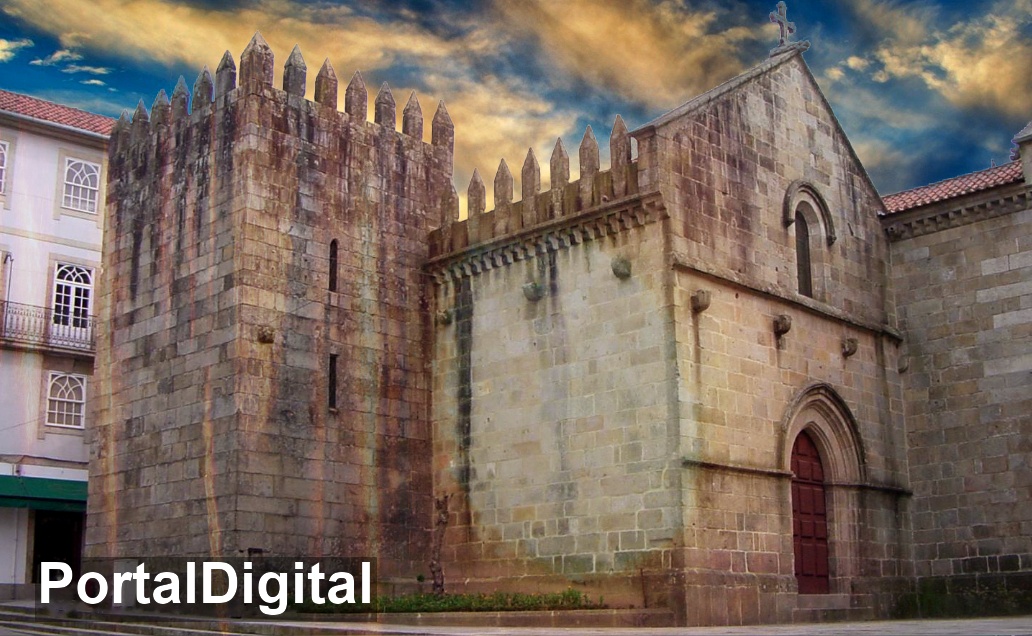
Rua Dom Paio Mendes, in Braga
The Chapels are integrated into the Braga Cathedral or Sé de Braga, located in the parish of Sé, city and municipality of Braga, northern Portugal.
The Main Temple or Cathedral of Braga is made up of 4 chapels: Chapel of São Geraldo, Chapel of the Kings, Chapel of Nossa Senhora da Glória and Chapel of Nossa Senhora da Piedade.
The premises outside the Cathedral: four chapels and cloisters maintain an inseparable relationship with the monument and were built over centuries and also reveal much of the History of the Braga cathedral space itself.
Before the restoration, the Santo Amaro Cloister was a covered enclosure surrounded by several chapels.
The intervention carried out at the beginning of the 20th century transformed it into an open space and temporarily housed in this space are the remains resulting from the successive interventions that this Primal Cathedral underwent.
The Romanesque apse stands out here, which is quite old in construction, perhaps belonging to the original project of the Cathedral.
Its round interior opens into a double arch that rests on two columns with cylindrical shafts and capitals with vegetal ornamentation.
The vault is decorated with a 15th century painting representing Our Lady of Loreto, as can be deduced from the Gothic legend.
The cloister of the Cathedral is a reconstruction from the end of the 18th century and beginning of the 19th century: it replaced the previous one, which was Gothic.
The Cloister of the Cathedral was ordered to be executed by the Chapter, after the death of Archbishop D. António de Freitas Honorato.
Currently, this privileged space of popular religiosity hosts different images, generally of recent execution, with the exception of Saint Ovídio, Altar das Almas (18th century), the Chapel of Santa Luzia, Saint Anne teaching the Virgin to Read (18th century, late – 19th century, early).
From the Cloister of Santo Amaro there are several private chapels, of which the following stand out: the Capela dos Reis, the Capela de São Gonçalo and the Capela de Nossa Senhora da Glória.
The Capela dos Reis and the Capela de São Gonçalo are made up of large spaces composed of a body and head.
The Main Temple or Cathedral of Braga is made up of 4 chapels: Chapel of São Geraldo, Chapel of the Kings, Chapel of Nossa Senhora da Glória and Chapel of Nossa Senhora da Piedade.
The premises outside the Cathedral: four chapels and cloisters maintain an inseparable relationship with the monument and were built over centuries and also reveal much of the History of the Braga cathedral space itself.
Before the restoration, the Santo Amaro Cloister was a covered enclosure surrounded by several chapels.
The intervention carried out at the beginning of the 20th century transformed it into an open space and temporarily housed in this space are the remains resulting from the successive interventions that this Primal Cathedral underwent.
The Romanesque apse stands out here, which is quite old in construction, perhaps belonging to the original project of the Cathedral.
Its round interior opens into a double arch that rests on two columns with cylindrical shafts and capitals with vegetal ornamentation.
The vault is decorated with a 15th century painting representing Our Lady of Loreto, as can be deduced from the Gothic legend.
The cloister of the Cathedral is a reconstruction from the end of the 18th century and beginning of the 19th century: it replaced the previous one, which was Gothic.
The Cloister of the Cathedral was ordered to be executed by the Chapter, after the death of Archbishop D. António de Freitas Honorato.
Currently, this privileged space of popular religiosity hosts different images, generally of recent execution, with the exception of Saint Ovídio, Altar das Almas (18th century), the Chapel of Santa Luzia, Saint Anne teaching the Virgin to Read (18th century, late – 19th century, early).
From the Cloister of Santo Amaro there are several private chapels, of which the following stand out: the Capela dos Reis, the Capela de São Gonçalo and the Capela de Nossa Senhora da Glória.
The Capela dos Reis and the Capela de São Gonçalo are made up of large spaces composed of a body and head.
The Chapel of São Geraldo da Sé de Braga
The Chapel of São Geraldo is located in the middle of Rua Dom Diogo de Sousa, parish of Sé, city of Braga, northern Portugal.
The Construction of the Chapel of São Geraldo da Sé de Braga
The primitive chapel, of which only the structure of the walls remains, was built by Archbishop Geraldo de Moissac under the invocation of Saint Nicholas.
In 1418-1467, Archbishop D. Fernando da Guerra, after São Geraldo de Moissac was considered a Saint, dedicated the Chapel to this former archbishop of Braga, and the remains of the Saint were buried in the main altarpiece. (São Geraldo is the patron saint of the city of Braga and is buried here).
The Chapel of S. Geraldo was built in the 12th century as a funerary chapel for the Archbishop who gave it its name.
After successive interventions, its interior was completely rebuilt in the 18th century by Archbishop D. Rodrigo de Moura Teles.
The Chapel was built in the 12th century and was sometimes remodeled, highlighting the gilded carving covered with gold leaves from Brazil.
In 1418-1467, Archbishop D. Fernando da Guerra, after São Geraldo de Moissac was considered a Saint, dedicated the Chapel to this former archbishop of Braga, and the remains of the Saint were buried in the main altarpiece. (São Geraldo is the patron saint of the city of Braga and is buried here).
The Chapel of S. Geraldo was built in the 12th century as a funerary chapel for the Archbishop who gave it its name.
After successive interventions, its interior was completely rebuilt in the 18th century by Archbishop D. Rodrigo de Moura Teles.
The Chapel was built in the 12th century and was sometimes remodeled, highlighting the gilded carving covered with gold leaves from Brazil.
The Characteristics of the Chapel of São Geraldo da Sé de Braga
The Chapel of São Geraldo is located at the top E. of the Courtyard with the same name with a facade finished in a gable with two registers, the lower one in projection and torn by an excavated portal with a pointed arch and with multiple archivolts, in the second register it has a window with two lights and highlighted by a frieze with a pointed profile based on corbels.
The chapel is decorated in baroque carving, the tiles are attributed to the painter António de Oliveira Bernardes, and on the floor is the tomb of D. Rodrigo de Moura Teles.
The Chapel of São Geraldo, despite being altered from a structural and planimetric point of view, maintains the covering of baroque tiles, in blue and white, dating from the Cycle of
Masters similar to those in the Chapel of São Pedro de Rates, both from the workshop of Oliveira Bernardes, as well as the gilded altarpiece in the national baroque style.
The chapel is decorated in baroque carving, the tiles are attributed to the painter António de Oliveira Bernardes, and on the floor is the tomb of D. Rodrigo de Moura Teles.
The Chapel of São Geraldo, despite being altered from a structural and planimetric point of view, maintains the covering of baroque tiles, in blue and white, dating from the Cycle of
Masters similar to those in the Chapel of São Pedro de Rates, both from the workshop of Oliveira Bernardes, as well as the gilded altarpiece in the national baroque style.
The Chapel of the Kings of the Cathedral of Braga
The Capela dos Reis is attached to the temple next to the Gospel with access through the cloister, facing Rua do Cabido, parish of Sé, city of Braga, northern Portugal.
The Characteristics of the Chapel of the Kings of the Cathedral of Braga
The Chapel is characterized by having a polygonal plan with facades in exposed granite stonework marked by stepped buttresses torn by pointed arched windows with two and three lights and a pointed arched access door based on projecting imposts.
For example, the construction of the Monastery of Santa Maria da Vitória da Batalha, in fulfillment of a vote of thanks for the victory of Portuguese weapons in the Battle of Aljubarrota made by João I of Portugal,,
This chapel was erected by the then archbishop of Braga, D. Lourenço Vicente, present at the same battle, in honor of the Virgin.
For example, the construction of the Monastery of Santa Maria da Vitória da Batalha, in fulfillment of a vote of thanks for the victory of Portuguese weapons in the Battle of Aljubarrota made by João I of Portugal,,
This chapel was erected by the then archbishop of Braga, D. Lourenço Vicente, present at the same battle, in honor of the Virgin.
The Construction of the Chapel of the Kings of the Cathedral of Braga
The Chapel of the Kings features Gothic style architecture founded in the 14th century by Archbishop D. Lourenço Vicente (1374-1397) who dedicated the mystery of the Annunciation and Assumption to the Virgin Mary, and to the martyrs S. Lourenço and S. Vicente.
In 1663 the tomb was opened, his body was found incorrupt and today rests in a tomb chest built during works at the end of the 20th century.
The tombs of Counts D. Henrique and D. Teresa (parents of the first king of Portugal), and D. Afonso Henriques (1109-1185), are those that in the 16th century D. Diogo de Sousa had executed and placed in the Main Chapel.
Following several renovations of the Braga Cathedral, the chests were transferred here at the end of the 19th century and placed in the two arches on the side wall of this chapel.
In the Capela dos Reis there are valuable tombs: that of Conde D. Henriques, his wife Teresa de Leão, and that of D. Lourenço Vicente and the notable execution of ribs in the text in a stone vault also stands out.
In 1663 the tomb was opened, his body was found incorrupt and today rests in a tomb chest built during works at the end of the 20th century.
The tombs of Counts D. Henrique and D. Teresa (parents of the first king of Portugal), and D. Afonso Henriques (1109-1185), are those that in the 16th century D. Diogo de Sousa had executed and placed in the Main Chapel.
Following several renovations of the Braga Cathedral, the chests were transferred here at the end of the 19th century and placed in the two arches on the side wall of this chapel.
In the Capela dos Reis there are valuable tombs: that of Conde D. Henriques, his wife Teresa de Leão, and that of D. Lourenço Vicente and the notable execution of ribs in the text in a stone vault also stands out.
The Facade of the Chapel of the Kings of the Cathedral of Braga
The facades in exposed granite stonework marked by stepped buttresses torn by pointed arched windows, with two and three lights and a pointed arched access door based on projecting imposts.
The Chapel of Our Lady of Glory of the Cathedral of Braga
The Chapel of Nossa Senhora da Glória faces Largo Dom João Peculiar, parish of Sé, city of Braga, northern Portugal.
The Construction of the Chapel of Nossa Senhora da Glória of the Cathedral of Braga
The Capela da Glória was built by Archbishop D. Gonçalo Pereira (1326 to 1348).
The Chapel is a Gothic construction from the 14th century and in the magnificent tomb with recumbent statue stands out a notable piece of the medieval Portuguese tomb where D. Gonçalo Pereira lies.
The tomb of D. Gonçalo Pereira was commissioned by the Archbishop from the masters Pêro, from Coimbra, and Telo Garcia, from Lisbon and was made in Ançã stone, the ark rests on lions and is decorated on the right side by a group of twelve clerics, and on the left by the twelve apostles.
The head of the ark is filled with the Crucified Christ flanked by his Mother and St. John and at the opposite top is the image of the Virgin with the child on her lap, the walls are decorated with geometric motifs reminiscent of Arabic art, in the middle of the wall on the right side is the coat of arms of D. Gonçalo Pereira, and on the left that of D. Afonso IV.
The Chapel is a Gothic construction from the 14th century and in the magnificent tomb with recumbent statue stands out a notable piece of the medieval Portuguese tomb where D. Gonçalo Pereira lies.
The tomb of D. Gonçalo Pereira was commissioned by the Archbishop from the masters Pêro, from Coimbra, and Telo Garcia, from Lisbon and was made in Ançã stone, the ark rests on lions and is decorated on the right side by a group of twelve clerics, and on the left by the twelve apostles.
The head of the ark is filled with the Crucified Christ flanked by his Mother and St. John and at the opposite top is the image of the Virgin with the child on her lap, the walls are decorated with geometric motifs reminiscent of Arabic art, in the middle of the wall on the right side is the coat of arms of D. Gonçalo Pereira, and on the left that of D. Afonso IV.
The Characteristics of the Chapel of Nossa Senhora da Glória of the Cathedral of Braga
The Capela da Glória is made up of the chapel and a tower topped with battlements, that is, the battlements are rectangular structures protruding from the top of the walls, a toothlike protrusion at the top of the temple.
The Capela da Glória is decorated with mural paintings forming “panellings”, that is, ornaments traditionally applied to a wooden panel with geometric patterns, and in the center the tomb of D. Gonçalo Pereira with recumbent and decorated by aedicules with imagery from the Gothic period.
Inside the Chapel of Nossa Senhora da Glória, the Spanish-Arabic fresco paintings from the 15th century stand out, an arched window with beautiful stained glass, a valuable sculpture of Saint Nicholas and the rich tomb of Dom Gonçalo Pereira.
The Capela da Glória is decorated with mural paintings forming “panellings”, that is, ornaments traditionally applied to a wooden panel with geometric patterns, and in the center the tomb of D. Gonçalo Pereira with recumbent and decorated by aedicules with imagery from the Gothic period.
Inside the Chapel of Nossa Senhora da Glória, the Spanish-Arabic fresco paintings from the 15th century stand out, an arched window with beautiful stained glass, a valuable sculpture of Saint Nicholas and the rich tomb of Dom Gonçalo Pereira.
The Facade of the Chapel of Nossa Senhora da Glória of the Cathedral of Braga
The main facade reproduces the previous one and the left side is based on a simple corbel.
The Construction of the Chapel of Nossa Senhora da Glória of the Cathedral of Braga
In March 1332, construction began on the Capela da Glória, built on the initiative of Archbishop D. Gonçalo Pereira for his funerary monument.
On November 17, 1331, Pope John XXII through the bull "Marita tuae devotionis" granted D. Gonçalo Pereira authorization to spend 6000 gold florins from the income of the archiepiscopal table on the endowment of the chapel he planned to build.
On November 17, 1331, Pope John XXII through the bull "Marita tuae devotionis" granted D. Gonçalo Pereira authorization to spend 6000 gold florins from the income of the archiepiscopal table on the endowment of the chapel he planned to build.
The Interior of the Chapel of Nossa Senhora da Glória of the Cathedral of Braga
This Chapel of Glory inside is built with a wooden ceiling and flagstone floor, the walls are covered with mural paintings forming geometric panels, in the center appears the tomb of D. Gonçalo Pereira, and on the pedestal, the image of the patron saint flanked by two niches of implements and on the Gospel side appears a lobed door leading to the tower.
The Chapel of Nossa Senhora da Glória of the Cathedral of Braga formed by 4 Altars
This Chapel has 4 altars which are the altar dedicated to the Virgin, the altar of Saint Andrew, the altar of Saint Mary Magdalene and the altar of Saint Lawrence and Saint Vincent.
The Chapel of Nossa Senhora da Glória of the Cathedral of Braga has the tomb of D. Goncalo Pereira
The Capela da Glória has the tomb of D. Gonçalo Pereira composed of an ark, surrounded by six lions with their faces covered by aedicules topped with mushrooms representing the Apostles and Prophets and at the top a calvary.
D. Gonçalo Pereira appears in pontifical robes, on his head he has a miter resting on cushions supported by angels and a third appears at his feet.
D. Gonçalo Pereira appears in pontifical robes, on his head he has a miter resting on cushions supported by angels and a third appears at his feet.
The Chapel of Nossa Senhora da Piedade of the Cathedral of Braga
The Chapel of Nossa Senhora da Piedade faces Rua do Cabido, parish of Sé, city of Braga, northern Portugal.
The Construction of the Chapel of Nossa Senhora da Piedade of the Cathedral of Braga
In 1513, the Capela da Piedade was founded on the initiative of Archbishop D. Diogo de Sousa with the intention of being his tomb chapel.
The Chapel of Nossa Senhora da Piedade is made up of five lateral and deep chapels, containing baroque carved altarpieces covered with 17th century tiles and has a carved altarpiece in the national baroque style.
Inside the Chapel, the 18th century tiles, the Renaissance main altar, a gilded altarpiece and the worked ceiling stand out.
The Chapel of Nossa Senhora da Piedade is made up of five lateral and deep chapels, containing baroque carved altarpieces covered with 17th century tiles and has a carved altarpiece in the national baroque style.
Inside the Chapel, the 18th century tiles, the Renaissance main altar, a gilded altarpiece and the worked ceiling stand out.
The High Choir of the Cathedral or Sé of Braga
At the end of the 1730s, the Capitulares Braga decided to replace the old chair in the high choir of the Cathedral, and Miguel Francisco da Silva, an architect and carver based in Porto at the end of the 1720s, was called to carry it out.
The Characteristics of the Chair of the High Choir of the Cathedral or Sé of Braga
The chair consists of two levels of seats and a chair for the archbishop topped by a carved clock and was made in rosewood, from which the gilded ornaments stand out.
The center of the choir is occupied by a majestic choir stand and executed in accordance with the decorative program of the high choir: that of the Johannine Baroque.
The center of the choir is occupied by a majestic choir stand and executed in accordance with the decorative program of the high choir: that of the Johannine Baroque.
The Organs of the Cathedral or Cathedral of Braga
The monumental organs of Braga Cathedral are musical instruments recognized for their liturgical, historical and artistic interest.
Included in the technical designation of Iberian organs, they appear installed on two balconies above the central nave, and form a magnificent baroque ensemble with a profusion of sculptural ornaments.
The execution of the organ cases (1737-1739) was entrusted to Frei Simão Fontana and their decoration was carried out by the Braga carver Marceliano de Araújo.
Included in the technical designation of Iberian organs, they appear installed on two balconies above the central nave, and form a magnificent baroque ensemble with a profusion of sculptural ornaments.
The execution of the organ cases (1737-1739) was entrusted to Frei Simão Fontana and their decoration was carried out by the Braga carver Marceliano de Araújo.
The Chapter of the Cathedral or Sé of Braga (a Corporation of Priests)
The Chapter of the Cathedral of Braga created by Bishop D. Pedro in 1071 is designated as a corporation of priests that carries out, within the scope of the Archdiocese of Braga, the ecclesiastical services attributed to it by the Code of Canon Law.
The Braga Metropolitan/Primacial Chapter or Chapter of the See of Braga is a corporation of priests that carries out, within the scope of the Archdiocese of Braga, the ecclesiastical services attributed to it by the Code of Canon Law or committed by the Diocesan Prelate.
A corporation of a legal nature, a consultative body and the Cathedral perform liturgical functions and ensure its conservation and heritage, promoting initiatives aimed at the evangelization of culture and history.
The Braga Metropolitan/Primacial Chapter or Chapter of the See of Braga is a corporation of priests that carries out, within the scope of the Archdiocese of Braga, the ecclesiastical services attributed to it by the Code of Canon Law or committed by the Diocesan Prelate.
A corporation of a legal nature, a consultative body and the Cathedral perform liturgical functions and ensure its conservation and heritage, promoting initiatives aimed at the evangelization of culture and history.