
Rua da Igreja in the parish of Palmeira in Braga
The D. Chica Castle or Palmeira Castle in Braga is located on Rua da Igreja, parish of Palmeira, City of Braga, Northern Portugal.
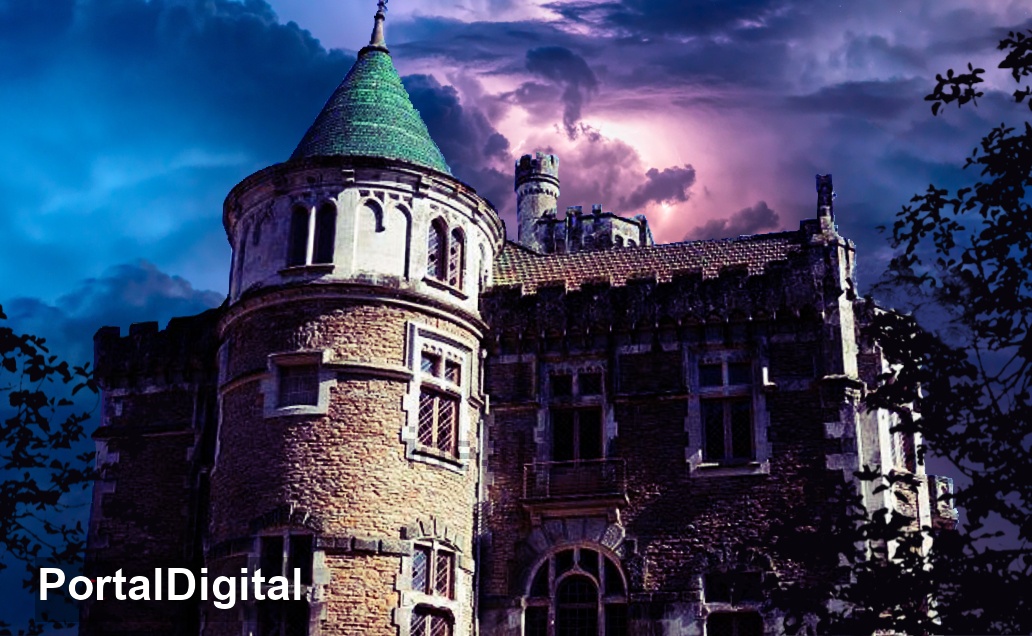
A Palace that is characterized by having elements in a revivalist style with neo-Gothic, neo-Renaissance and neoclassical elements and develops a diversity of use of materials, and in the analysis of the construction details the importance given to the image and decorative elements is observed.
This building, following the romantic taste of the time, includes a lake, a cave and several artificial canals and is characterized by curves and winding paths, a shaded area and a resting place.
A Palace that is characterized by having elements in a revivalist style with neo-Gothic, neo-Renaissance and neoclassical elements and develops a diversity of use of materials, and in the analysis of the construction details the importance given to the image and decorative elements is observed.
This building, following the romantic taste of the time, includes a lake, a cave and several artificial canals and is characterized by curves and winding paths, a shaded area and a resting place.
The History of D. Chica Castle in the parish of Palmeira in Braga
D. A Chica Castle was designed by architect Ernesto Korrodi in 1915 to serve as a home for J. Ferreira do Rego and his wife, Brazilian Francisca Peixoto Rego, to whom the popular name of the property refers.
Its construction began in 1915 on the initiative of Francisca Peixoto de Sousa, born in Brazil, who ordered many of the tree species currently found in the surrounding forest to come from her country.
This project arises in the context of the "Noble Provincial Housing", a type of house that Korrodi dedicated himself to at the beginning of the 20th century, and which evoked, through different sources of inspiration, an art of the Middle Ages and a certain social experience that the triumphant bourgeoisie of the 19th century was based on, at the same time, tradition and progress.
Construction, interrupted in 1919, left the work incomplete, particularly the interior space.
Although the built structure presents some solutions that differ from the initial project designed by Korrodi, this evolution marks the materialization of his Noble Dwelling, which refers mainly to neo-Gothic references that in the decorative ensemble are mixed with elements inspired by new, Renaissance and even Romanesque art.
Throughout its history, it changed ownership several times, with the works taking decades and only being completed in 1991, and this year it was adapted into a restaurant and bar.
Its construction began in 1915 on the initiative of Francisca Peixoto de Sousa, born in Brazil, who ordered many of the tree species currently found in the surrounding forest to come from her country.
This project arises in the context of the "Noble Provincial Housing", a type of house that Korrodi dedicated himself to at the beginning of the 20th century, and which evoked, through different sources of inspiration, an art of the Middle Ages and a certain social experience that the triumphant bourgeoisie of the 19th century was based on, at the same time, tradition and progress.
Construction, interrupted in 1919, left the work incomplete, particularly the interior space.
Although the built structure presents some solutions that differ from the initial project designed by Korrodi, this evolution marks the materialization of his Noble Dwelling, which refers mainly to neo-Gothic references that in the decorative ensemble are mixed with elements inspired by new, Renaissance and even Romanesque art.
Throughout its history, it changed ownership several times, with the works taking decades and only being completed in 1991, and this year it was adapted into a restaurant and bar.
The Characteristics of D. Chica Castle in the parish of Palmeira in Braga
The building consists of four floors, expanded in a very accentuated set of volumes, and is characterized by popular and erudite references in an extravagant eclecticism where neo-Gothic, neo-Arabic and "rustic" styles are mixed.
The isolated volumes have their own image and establish connections through some bridges and present decorative elements, and the analysis of the construction details highlights the importance given to the image.
The windows are made of wood or iron, and follow a construction project initially defined by the architect Korrodi, and the construction work would be the responsibility of the different artists/craftsmen who carried them out.
Iron is also used in the railing, in the crowning of the roof, in the weather vane, the repetition of the "ivy leaf" as a decorative element, in the design of the iron railings and in some marble frames with the application of different floral motifs, in the capitals of the different columns with geometric rosettes, in the closures of the pointed arches, and the tiles are colored green.
The surrounding forest is characterized by exotic vegetation (Brazilian almond trees, Brazilian rosewood, Brazilian pine, palm trees, eucalyptus trees, Japanese trees and others) and many national varieties (oak, plane trees, cedars, maritime pine, chestnut trees, willows, mimosas, cork oaks and others) with trails to explore the terrain.
The lake with a cave stands out, translating a romantic vision that intended to imitate the medieval period by reproducing nature, and preferring the "forest" to the geometric baroque garden.
The isolated volumes have their own image and establish connections through some bridges and present decorative elements, and the analysis of the construction details highlights the importance given to the image.
The windows are made of wood or iron, and follow a construction project initially defined by the architect Korrodi, and the construction work would be the responsibility of the different artists/craftsmen who carried them out.
Iron is also used in the railing, in the crowning of the roof, in the weather vane, the repetition of the "ivy leaf" as a decorative element, in the design of the iron railings and in some marble frames with the application of different floral motifs, in the capitals of the different columns with geometric rosettes, in the closures of the pointed arches, and the tiles are colored green.
The surrounding forest is characterized by exotic vegetation (Brazilian almond trees, Brazilian rosewood, Brazilian pine, palm trees, eucalyptus trees, Japanese trees and others) and many national varieties (oak, plane trees, cedars, maritime pine, chestnut trees, willows, mimosas, cork oaks and others) with trails to explore the terrain.
The lake with a cave stands out, translating a romantic vision that intended to imitate the medieval period by reproducing nature, and preferring the "forest" to the geometric baroque garden.
The Classification of D. Chica Castle in the parish of Palmeira in Braga
This building was approved as a Property of Public Interest by Order of February 20, 1985.