
Rua do Raio, in Braga
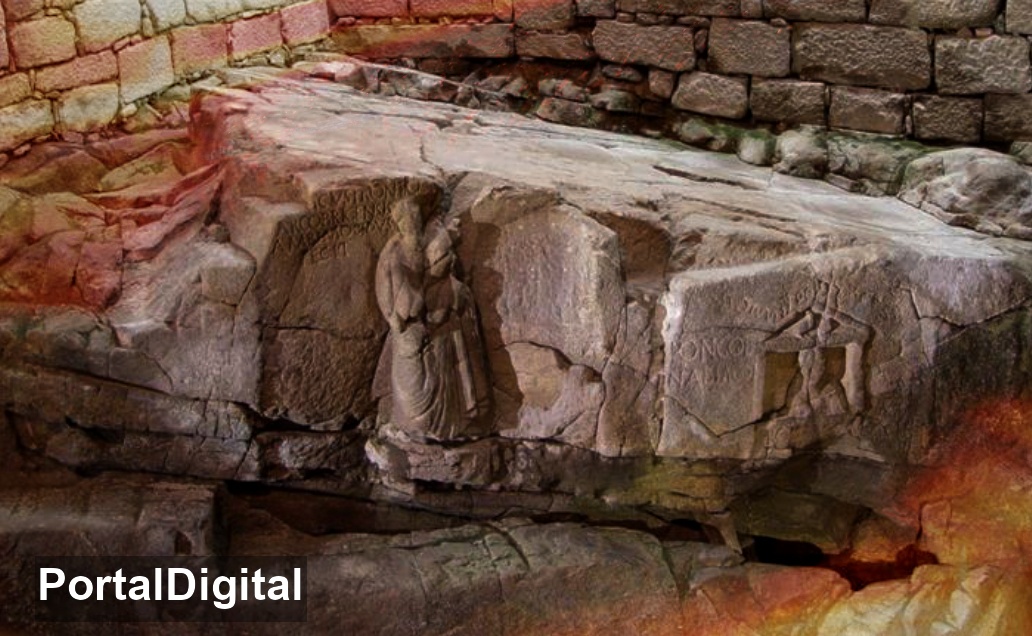
Fonte do Ídolo, located on Rua do Raio, near Avenida da Liberdade, in the city of Braga, northern Portugal.
When we talk about deities, the name of the God Tongoenabiago is not part of the first list that comes to mind. However, in the 1st century, the people who inhabited the territory of northern Portugal did not think that way and decided to honor the God Tongoenabiago by building a fountain in his tribute. Today, this century-old monument is called Fountain of the Idol.
The value of Fonte do Ídolo, located near Avenida da Liberdade, goes beyond the work implicit in its construction. The historical data it reveals is of enormous importance, allowing us to confirm, for example, the existence of a Lusitanian Mythology that in no way differed from Roman and Greek mythology.
According to traces found near the fountain, there are researchers who believe that the monument could have been a constituent element of a domus on the outskirts, while others consider that we are in front of a public sanctuary offered to the Braga community by Celico Fronto – a fact that makes the Fonte do Ídolo one of the few examples of evergetism in the city of Bracara Augusta.
However, the Fountain of the Idol has another peculiarity that makes it enigmatic and controversial. The two figures represented in the source do not reach consensus, and several personalities have divergent opinions regarding the question of who is who. The list of doubts includes three figures.
On the one hand, José Leite de Vasconcelos explains that the God Tongoenabiago is represented in the bust inside the Aedicle and Celico Fronto, the edifier of the fountain, represented in high relief.
On the other hand, Alain Tranoy argues precisely the opposite. The God Tongoenabiago is represented in high relief and is Celico Fronto who corresponds to the bust inside the Aedicule.
However, there are those who have another opinion, such as António Rodríguez Comenero, who states that Celico Fronto is only mentioned in the inscriptions and is not represented either in the bust or in high relief. The God Tongoenabiago will be portrayed in the bust inside the Aedicule and the Goddess Nabia in high relief.
The best thing is to visit the place with company to discuss the controversial interpretation!
When we talk about deities, the name of the God Tongoenabiago is not part of the first list that comes to mind. However, in the 1st century, the people who inhabited the territory of northern Portugal did not think that way and decided to honor the God Tongoenabiago by building a fountain in his tribute. Today, this century-old monument is called Fountain of the Idol.
The value of Fonte do Ídolo, located near Avenida da Liberdade, goes beyond the work implicit in its construction. The historical data it reveals is of enormous importance, allowing us to confirm, for example, the existence of a Lusitanian Mythology that in no way differed from Roman and Greek mythology.
According to traces found near the fountain, there are researchers who believe that the monument could have been a constituent element of a domus on the outskirts, while others consider that we are in front of a public sanctuary offered to the Braga community by Celico Fronto – a fact that makes the Fonte do Ídolo one of the few examples of evergetism in the city of Bracara Augusta.
However, the Fountain of the Idol has another peculiarity that makes it enigmatic and controversial. The two figures represented in the source do not reach consensus, and several personalities have divergent opinions regarding the question of who is who. The list of doubts includes three figures.
On the one hand, José Leite de Vasconcelos explains that the God Tongoenabiago is represented in the bust inside the Aedicle and Celico Fronto, the edifier of the fountain, represented in high relief.
On the other hand, Alain Tranoy argues precisely the opposite. The God Tongoenabiago is represented in high relief and is Celico Fronto who corresponds to the bust inside the Aedicule.
However, there are those who have another opinion, such as António Rodríguez Comenero, who states that Celico Fronto is only mentioned in the inscriptions and is not represented either in the bust or in high relief. The God Tongoenabiago will be portrayed in the bust inside the Aedicule and the Goddess Nabia in high relief.
The best thing is to visit the place with company to discuss the controversial interpretation!