
Serra da Falperra, in Braga
The Church of Santa Maria Madalena, also known as the Church of Falperra, is located in the Serra da Falperra, parish of Nogueira, on the outskirts of the city of Braga, northern Portugal.
The History of the Church of Santa Maria Madalena da Falperra
The first references to the existence of a chapel on Monte da Falperra date back to the archbishopric of D. Diogo de Sousa (1461-1532) who ordered works on a medieval chapel on the site, namely the execution of altarpieces and painting of the main chapel.
In the second half of the 1600s, new works were carried out, including the gilding of the altarpieces.
In 1693, the Brotherhood of Santa Maria Madalena da Falperra, responsible for the space since 1635, decided to rebuild the chapel in a more prominent location, especially one that was visible from the city of Braga.
The temple, with a diamond-shaped plan, was designed in the final years of the 17th century and its author is unknown.
In 1752, the brotherhood intended to create the new façade of the chapel and hand over the project to the architect João da Costa.
However, the design of the work was signed by the carver-architect André Soares (1720-1769), with the work being carried out by the masters João Rodrigues and Domingos Álvares.
The architect André Soares, who was accepted as a member of the brotherhood, also designed the grand staircase and the main altarpiece in 1763.
The Falperra Sanctuary complex presents itself as one of the most notable works by architect André Soares, the wonderful façade marked the entry into the Rococo style in Braga's architecture.
In the second half of the 1600s, new works were carried out, including the gilding of the altarpieces.
In 1693, the Brotherhood of Santa Maria Madalena da Falperra, responsible for the space since 1635, decided to rebuild the chapel in a more prominent location, especially one that was visible from the city of Braga.
The temple, with a diamond-shaped plan, was designed in the final years of the 17th century and its author is unknown.
In 1752, the brotherhood intended to create the new façade of the chapel and hand over the project to the architect João da Costa.
However, the design of the work was signed by the carver-architect André Soares (1720-1769), with the work being carried out by the masters João Rodrigues and Domingos Álvares.
The architect André Soares, who was accepted as a member of the brotherhood, also designed the grand staircase and the main altarpiece in 1763.
The Falperra Sanctuary complex presents itself as one of the most notable works by architect André Soares, the wonderful façade marked the entry into the Rococo style in Braga's architecture.
The Construction of the Church of Santa Maria Madalena da Falperra
The Church of Santa Maria Madalena da Falperra is one of the most emblematic Baroque-Rococo buildings and is located in a forest landscape of great beauty.
The church was built in the 18th century, designed by architect André Soares, on the initiative of Archbishop D. Rodrigo de Moura Telles, and is an example of Baroque religious architecture.
This temple is made up of the building of the Chapel of Santa Maria Madalena and is located in the highest part of a small elevation.
Traditional access for pilgrims to the church grounds is from the sides via a long, sloping pedestrian promenade that brings several other religious buildings into contact with the temple.
On the north side, the starting point is the crossing and also a small chapel-oratory, on the south, the promenade begins in the yard in front of the chapel of Santo António and the old convent of Varatojo (today a hotel), the chapel of Santa Marta do Leão (so named because of the Leão Fountain built in the neighborhood).
On the upper levels of the hill are the chapel of Santa Marta das Cortiças and the homonymous archaeological station.
The church was built in the 18th century, designed by architect André Soares, on the initiative of Archbishop D. Rodrigo de Moura Telles, and is an example of Baroque religious architecture.
This temple is made up of the building of the Chapel of Santa Maria Madalena and is located in the highest part of a small elevation.
Traditional access for pilgrims to the church grounds is from the sides via a long, sloping pedestrian promenade that brings several other religious buildings into contact with the temple.
On the north side, the starting point is the crossing and also a small chapel-oratory, on the south, the promenade begins in the yard in front of the chapel of Santo António and the old convent of Varatojo (today a hotel), the chapel of Santa Marta do Leão (so named because of the Leão Fountain built in the neighborhood).
On the upper levels of the hill are the chapel of Santa Marta das Cortiças and the homonymous archaeological station.
The Characteristics of the Chapel of Santa Maria Madalena da Falperra
The Chapel of Santa Maria Madalena da Falperra has a curious plan centered on a rhombus interrupted by a rectangular body that corresponds to the main facade, a covered atrium and a high choir.
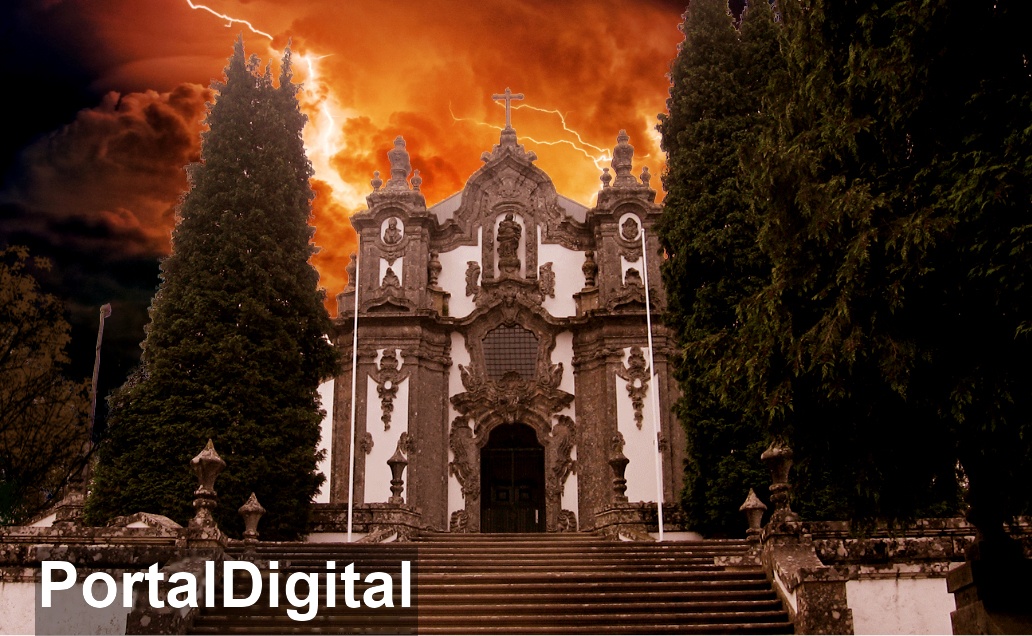
The frontispiece, with an exuberant rococo design, is divided into three panels and two registers, demarcated by granite decoration, in contrast to the white burial cloths.
On the central axis is the portal, decorated all around with shells and volutes, topped by a large window, which illuminates the choir internally, and by a frame with the image of the patron saint.
The whole is topped with a counter-curved pediment, with the lateral bodies erected in the form of towers, profusely decorated.
The frontispiece, with an exuberant rococo design, is divided into three panels and two registers, demarcated by granite decoration, in contrast to the white burial cloths.
On the central axis is the portal, decorated all around with shells and volutes, topped by a large window, which illuminates the choir internally, and by a frame with the image of the patron saint.
The whole is topped with a counter-curved pediment, with the lateral bodies erected in the form of towers, profusely decorated.
The Characteristics of the Chapel of Saint Mary Magdalene: "The Penitent"
The small chapel with a quadrangular plan, with an altar dedicated to Stª Maria Madalena and popularly known as "Nicho" is located at the beginning of an avenue of cork oaks and oaks that leads to the north side of the Chapel of Santa Maria Madalena, and the roof is in a pyramidal shape topped by a stone spire.
The existence of a Cruise
This cross is based on three steps and is dated 1775, and is located in front of the chapel on a landing that follows the first flight of stairs.
The renovations of the Church of Santa Maria Madalena da Falperra
In the 16th century, Monte da Falperra was called Portela de Espinho where a hermitage dedicated to Santa Maria Madalena stood.
In 1532, Archbishop D. Diogo de Sousa ordered work to be carried out in the chapel with the opening of openings, painting of the main chapel and transept where there were three altars, as well as the tearing down of the cuts that were in the walls of the property.
On August 16, 1693, the decision to build a new church was made, to which Canon Bento de Carvalho contributed, and on November 20, the stonework was commissioned by Domingos da Silva,
On May 16, 1694, the first stone was laid, blessed by the confrere Father Cipriano Coelho, and on September 23, 1736, the carpentry work was carried out by Miguel Ferreira, with the wood supplied by the Confraternity.
In 1737, five doors were built, the main one and the four sides by Master Miguel Francisco, the roofs, vaults and walls were built by Domingos Moreira, and on 19 June the church was blessed by the Brotherhood's chaplain, with a license from the Chapter in a vacant seat.
In 1738 the image of Santa Marta was placed, and in 1747 the main façade was rebuilt.
On November 1, 1755, the earthquake caused the ruin of the church, the plan for its reconstruction was made by André Soares, and sponsored by Archbishop D. Rodrigo de Moura Teles.
In 1532, Archbishop D. Diogo de Sousa ordered work to be carried out in the chapel with the opening of openings, painting of the main chapel and transept where there were three altars, as well as the tearing down of the cuts that were in the walls of the property.
On August 16, 1693, the decision to build a new church was made, to which Canon Bento de Carvalho contributed, and on November 20, the stonework was commissioned by Domingos da Silva,
On May 16, 1694, the first stone was laid, blessed by the confrere Father Cipriano Coelho, and on September 23, 1736, the carpentry work was carried out by Miguel Ferreira, with the wood supplied by the Confraternity.
In 1737, five doors were built, the main one and the four sides by Master Miguel Francisco, the roofs, vaults and walls were built by Domingos Moreira, and on 19 June the church was blessed by the Brotherhood's chaplain, with a license from the Chapter in a vacant seat.
In 1738 the image of Santa Marta was placed, and in 1747 the main façade was rebuilt.
On November 1, 1755, the earthquake caused the ruin of the church, the plan for its reconstruction was made by André Soares, and sponsored by Archbishop D. Rodrigo de Moura Teles.
The Facade of the Church of Santa Maria Madalena da Falperra
This building has a plan from the end of the 17th century, and in the middle of the following century, between 1753 and 1756, it was given a facade with a design attributed to the architect André Soares.
This façade clearly shows the decorative opulence that the granite uses in undulating and exuberant forms, and was considered to have the most ornaments from the Manueline period.
The main façade with a concave profile given by the protruding arrangement of the towers, with a portal in the center with a counter-curved profile, a cut-out frame with shell-shaped ears, finished with fragments of cornice and a false closing stone of volutes and shells, is topped by a trapezoidal window, wavy at the top, with a frame that is also cut and voluminous, and by a plinth supporting the large image of the patron saint surrounded by a semi-circular frame.
The facade has a high finish, with a double frieze and a cornice against Borromini-inspired curves, with a Latin cross at the apex, slightly recessed, a simple gable.
The towers are symmetrical and composed of two blind registers, divided by an architrave with a convex frieze, the lower one being wider and having pilasters with Ionic capitals at the angles, topped by bonfires, whose plinths spill over to the second register, which is topped by a counter-curved cornice, covered in bulbous coruches with bonfires at the angles and at the apex.
The frontal panels of both registers have shell elements, with an oval medallion at the top featuring the busts of Saint Lázaro (left side) and Saint Martha (right side).
The side facades are similar, forming two panels at an obtuse angle, torn by rectilinear framed openings corresponding to a capital window in each panel and a straight lintel door, and in the second both framed.
On the left side, the nave enters and the main chapel appears the body of the single-storey sacristy.
This façade clearly shows the decorative opulence that the granite uses in undulating and exuberant forms, and was considered to have the most ornaments from the Manueline period.
The main façade with a concave profile given by the protruding arrangement of the towers, with a portal in the center with a counter-curved profile, a cut-out frame with shell-shaped ears, finished with fragments of cornice and a false closing stone of volutes and shells, is topped by a trapezoidal window, wavy at the top, with a frame that is also cut and voluminous, and by a plinth supporting the large image of the patron saint surrounded by a semi-circular frame.
The facade has a high finish, with a double frieze and a cornice against Borromini-inspired curves, with a Latin cross at the apex, slightly recessed, a simple gable.
The towers are symmetrical and composed of two blind registers, divided by an architrave with a convex frieze, the lower one being wider and having pilasters with Ionic capitals at the angles, topped by bonfires, whose plinths spill over to the second register, which is topped by a counter-curved cornice, covered in bulbous coruches with bonfires at the angles and at the apex.
The frontal panels of both registers have shell elements, with an oval medallion at the top featuring the busts of Saint Lázaro (left side) and Saint Martha (right side).
The side facades are similar, forming two panels at an obtuse angle, torn by rectilinear framed openings corresponding to a capital window in each panel and a straight lintel door, and in the second both framed.
On the left side, the nave enters and the main chapel appears the body of the single-storey sacristy.
Interior of the Church of Santa Maria Madalena da Falperra
The interior space has a centralized plan with a deep chancel, open along the entrance axis, featuring a large rococo polychrome carved altar that houses the image of Christ Crucified over the niche where the image of Saint Mary Magdalene is inserted.
The side chapels, also deep, display two rococo polychrome altarpieces with large images, the main ones being those of Santo António and Nossa Senhora da Conceição.
The small hermitage of Santa Maria Madalena Penitente is a quadrangular building with a pyramidal top and an interior altar, erected on the road that leads to the main temple, and the cross, based on three stone sockets, was built in front of it in 1775, as shown by the inscription.
The interior is covered in 18th century tiles designed by the ceramist Policarpo de Oliveira Bernardes.
The side chapels, also deep, display two rococo polychrome altarpieces with large images, the main ones being those of Santo António and Nossa Senhora da Conceição.
The small hermitage of Santa Maria Madalena Penitente is a quadrangular building with a pyramidal top and an interior altar, erected on the road that leads to the main temple, and the cross, based on three stone sockets, was built in front of it in 1775, as shown by the inscription.
The interior is covered in 18th century tiles designed by the ceramist Policarpo de Oliveira Bernardes.
Classification
On November 3, 2016, the Council of Ministers approved the classification of the Sanctuary of Santa Maria Madalena da Falperra as a national monument.
The classification is based on the government's understanding that that complex is “a monument with high historical and religious interest, in addition to its intrinsic aesthetic, technical and material value, its architectural, urban and landscape design, as well as its importance in terms of collective memory”.
The classification is based on the government's understanding that that complex is “a monument with high historical and religious interest, in addition to its intrinsic aesthetic, technical and material value, its architectural, urban and landscape design, as well as its importance in terms of collective memory”.