
Rua de São Vicente, in Braga
The Church of São Vicente, also referred to as the Parish Church of São Vicente, is located in the parish of São Vicente, city of Braga, northern Portugal.
This church was built in 1565 and restored in 1691, São Vicente stands on the site of a much earlier Visigothic church. As with many Catholic churches, the very functional exterior does not betray the luxurious interior.
This temple dates back to a primitive temple, possibly destroyed in the context of the Muslim invasion of the Iberian peninsula, from which we are left with a Visigothic tombstone with an epigraphic inscription, currently on the sacristy wall, measuring 1.40 meters long by 0.41 meters high.
The current temple, under the invocation of Saint Vincent, was rebuilt in the mid-16th century and was the subject of extensive restoration work in 1691.
This church was built in 1565 and restored in 1691, São Vicente stands on the site of a much earlier Visigothic church. As with many Catholic churches, the very functional exterior does not betray the luxurious interior.
This temple dates back to a primitive temple, possibly destroyed in the context of the Muslim invasion of the Iberian peninsula, from which we are left with a Visigothic tombstone with an epigraphic inscription, currently on the sacristy wall, measuring 1.40 meters long by 0.41 meters high.
The current temple, under the invocation of Saint Vincent, was rebuilt in the mid-16th century and was the subject of extensive restoration work in 1691.
Interior
Inside, the highlights include the choir, attributed to Carlos Amarante, the organ, built by master organ maker Francisco António Solha in 1769, and the tile panels, dating from 1873, produced by the Fábrica de Cerâmica das Devesas.
On the walls are two large paintings by Carlos António Leoni illustrating the martyrdom of Saint Vincent.
On the walls are two large paintings by Carlos António Leoni illustrating the martyrdom of Saint Vincent.
Facade
Its bell tower, located behind the main chapel (a typical architectural solution of the Braga baroque), was the tallest building in the city, and therefore suffered electrical discharges from thunderstorms. Twice the tower had to be rebuilt, the last time in 1812.
Until the mid-70s of the 20th century, the tower was crowned by a majestic weathervane and it is known that it was designed and built by one of the most important blacksmiths of the time, João de Araújo Faúlhas, in 1743.
On March 7, 1813, the brotherhood of São Vicente decided to place a lead box with several relics next to the tower's roof after the last reconstruction, to protect it from thunderstorms.
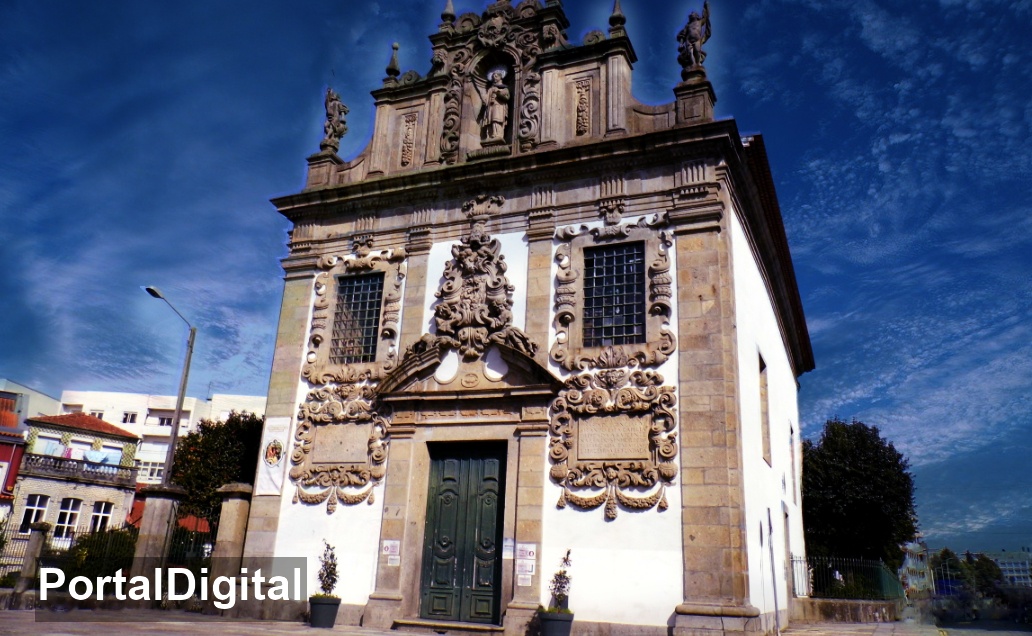
It is a Baroque style church and the facade with Mannerist elements, decorated with elements of a clearly Baroque nature, has been attributed to Frei Luís de S. José, the same person who designed the front of the Church of the Monastery of Alcobaça.
Topping the front is the image of the patron saint, St. Vincent, nestled in a niche and crowning the façade is a papal cross that recalls the privileges and indulgences that Pope Clement VIII granted to this church around 1598 during the time of Archbishop Agostinho de Jesus.
Until the mid-70s of the 20th century, the tower was crowned by a majestic weathervane and it is known that it was designed and built by one of the most important blacksmiths of the time, João de Araújo Faúlhas, in 1743.
On March 7, 1813, the brotherhood of São Vicente decided to place a lead box with several relics next to the tower's roof after the last reconstruction, to protect it from thunderstorms.
It is a Baroque style church and the facade with Mannerist elements, decorated with elements of a clearly Baroque nature, has been attributed to Frei Luís de S. José, the same person who designed the front of the Church of the Monastery of Alcobaça.
Topping the front is the image of the patron saint, St. Vincent, nestled in a niche and crowning the façade is a papal cross that recalls the privileges and indulgences that Pope Clement VIII granted to this church around 1598 during the time of Archbishop Agostinho de Jesus.