
Rua do Raio, in Braga
Palácio do Raio is located on Rua do Raio, parish of São José de São Lázaro, city of Braga, northern Portugal.
The History of Palácio do Raio in Braga
The Palácio do Raio was built between 1754-1755 by João Duarte de Faria, a powerful merchant from Braga, and designed by the Braga architect André Soares.
The property was sold in 1853 by José Maria Duarte Peixoto, to Miguel José Raio, Viscount of São Lázaro, and has since become known as "Palácio do Raio".
The viscount, born in Braga, made his fortune in Brazil and in 1863, he opened the street in front of the palace to allow a better view of his house, and to be able to build two houses for his daughters.
The Viscount of São Lázaro, Miguel José Raio, died in 1882, and due to economic difficulties, his heirs handed over the palace to Banco do Minho on December 28, 1882, which, in turn, resold it on October 1, 1883 to Santa Casa de Misericórdia, which installed some of the services of the São Marcos Hospital there.
In 1912 it returned to the ownership of the Misericórdia de Braga, which carried out extensive restoration work.
The property was sold in 1853 by José Maria Duarte Peixoto, to Miguel José Raio, Viscount of São Lázaro, and has since become known as "Palácio do Raio".
The viscount, born in Braga, made his fortune in Brazil and in 1863, he opened the street in front of the palace to allow a better view of his house, and to be able to build two houses for his daughters.
The Viscount of São Lázaro, Miguel José Raio, died in 1882, and due to economic difficulties, his heirs handed over the palace to Banco do Minho on December 28, 1882, which, in turn, resold it on October 1, 1883 to Santa Casa de Misericórdia, which installed some of the services of the São Marcos Hospital there.
In 1912 it returned to the ownership of the Misericórdia de Braga, which carried out extensive restoration work.
The renovations of the Palácio do Raio in Braga
In 1993, the portal and windows on the first floor were restored, with insulation of the woodwork, wet cleaning of the stone, execution of molds, placement of artificial stone, removal of cement, and reintegration of sculptural elements.
The rocaille facade and staircase of the Palácio do Raio in Braga
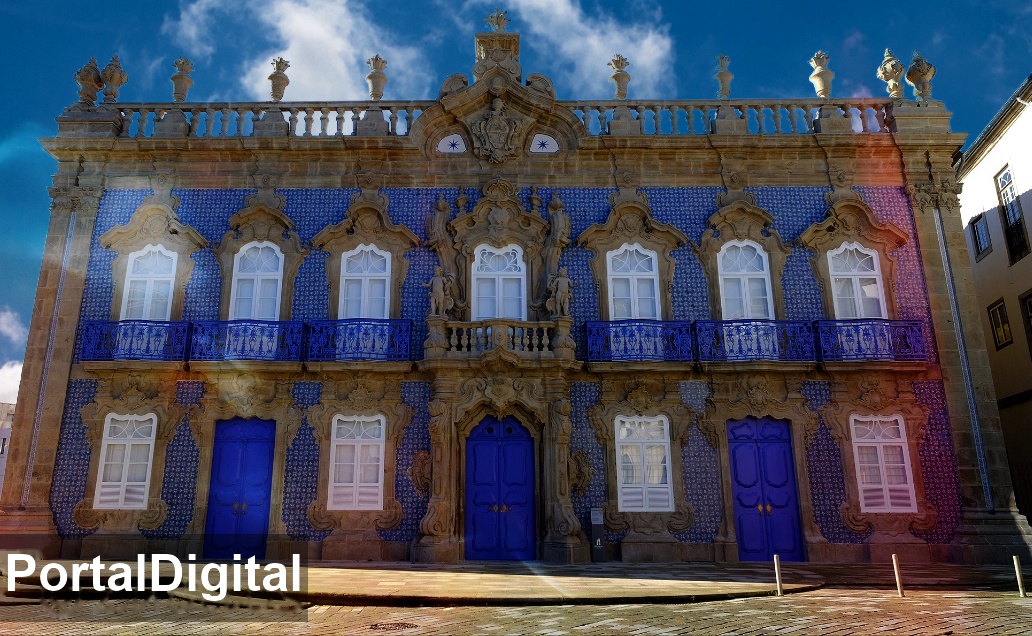
The exuberance of the decoration stands out on the facade, the richly crafted central door has 4 windows and 3 doors on the lower floor, 7 windows on the upper floor with a balcony divided between the two floors and on the top there is a large terrace.
The ornaments are asymmetrical, giving the building a dynamic and drama that are common in the work of architect André Soares.
At the end of the 19th century, blue tiles were placed on the facade, a door with colored glass that separates the atrium from the stairwell, painting of the ceilings and the stairwell, attributed to the Portuguese painter and decorator, José Maria Pereira Júnior, better known as Pereira Cão.
Palácio do Raio owes its name to one of the owners, Visconde de São Lázaro Miguel José Raio, who acquired this property in 1867.
However, its construction dates back to 1754-1755.
At this time, a powerful merchant from Braga, João Duarte de Faria, must have commissioned the layout of the manor house from André Soares, the architect (who developed activities in other areas, such as carving) from Braga, who was one of the greatest exponents of the development of the city of Cardeais, during the second half of the 18th century.
The architect André Soares was based on the interpretation of Franco-German engravings, creating a European Rococo style.
This work is characterized by monumentality, plasticity of forms, very characteristic naturalistic decoration, with shells, vases, garlands and festoons.
In the context of Portuguese art, André Soares falls between the end of the Baroque and the beginning of the Rococo, a situation that is reflected in his architecture where the structure is Baroque but the decoration is Rococo.
The Palácio do Raio do Raio is characterized by having a baroque structure and rococo decoration and considered one of the most important works by this artist.
The Raio Palace has a profusely decorated façade, in which the general symmetry contrasts with the asymmetries introduced by the window pediments
The window that overlaps the portal is connected to a curved pediment, reminiscent of that of the church of Santa Maria Madalena, the decoration is designed to stand out strongly from the rest of the facade, the tiles that cover it were incorporated from the 19th century.
Through the sensual and powerful sense of deconstruction of the openings that the building imposes itself in novelty and apparatus, in a sensual strength rhythmic to rocaille that continues along the noble staircase adorned by the singular Turkish as an exotic figure of invitation.
This building has typical Baroque architecture and was built during the time of D. João V.
Above the deeply cut portal, there is a sumptuous balcony with balusters flanked by two decorative sculptures.
The balcony lintel is monolithic, the exceptionally prominent cornice is crowned by a balustrade with six flaming fires and four amphorae at the ends, doors in the extension of the four Ionic pilasters that frame the beautiful elevation on the flanks.
The main floor is embellished by the design of the carved granite moldings and the cutout of the wrought iron balconies.
The facade is covered in tiles and the entire building is made of granite and the staircase is 2 flights from the middle floor.
This building features trimmed granite plinths, masonry walls, chestnut wood floors, granite door and window frames and tiled coverings.
The ornaments are asymmetrical, giving the building a dynamic and drama that are common in the work of architect André Soares.
At the end of the 19th century, blue tiles were placed on the facade, a door with colored glass that separates the atrium from the stairwell, painting of the ceilings and the stairwell, attributed to the Portuguese painter and decorator, José Maria Pereira Júnior, better known as Pereira Cão.
Palácio do Raio owes its name to one of the owners, Visconde de São Lázaro Miguel José Raio, who acquired this property in 1867.
However, its construction dates back to 1754-1755.
At this time, a powerful merchant from Braga, João Duarte de Faria, must have commissioned the layout of the manor house from André Soares, the architect (who developed activities in other areas, such as carving) from Braga, who was one of the greatest exponents of the development of the city of Cardeais, during the second half of the 18th century.
The architect André Soares was based on the interpretation of Franco-German engravings, creating a European Rococo style.
This work is characterized by monumentality, plasticity of forms, very characteristic naturalistic decoration, with shells, vases, garlands and festoons.
In the context of Portuguese art, André Soares falls between the end of the Baroque and the beginning of the Rococo, a situation that is reflected in his architecture where the structure is Baroque but the decoration is Rococo.
The Palácio do Raio do Raio is characterized by having a baroque structure and rococo decoration and considered one of the most important works by this artist.
The Raio Palace has a profusely decorated façade, in which the general symmetry contrasts with the asymmetries introduced by the window pediments
The window that overlaps the portal is connected to a curved pediment, reminiscent of that of the church of Santa Maria Madalena, the decoration is designed to stand out strongly from the rest of the facade, the tiles that cover it were incorporated from the 19th century.
Through the sensual and powerful sense of deconstruction of the openings that the building imposes itself in novelty and apparatus, in a sensual strength rhythmic to rocaille that continues along the noble staircase adorned by the singular Turkish as an exotic figure of invitation.
This building has typical Baroque architecture and was built during the time of D. João V.
Above the deeply cut portal, there is a sumptuous balcony with balusters flanked by two decorative sculptures.
The balcony lintel is monolithic, the exceptionally prominent cornice is crowned by a balustrade with six flaming fires and four amphorae at the ends, doors in the extension of the four Ionic pilasters that frame the beautiful elevation on the flanks.
The main floor is embellished by the design of the carved granite moldings and the cutout of the wrought iron balconies.
The facade is covered in tiles and the entire building is made of granite and the staircase is 2 flights from the middle floor.
This building features trimmed granite plinths, masonry walls, chestnut wood floors, granite door and window frames and tiled coverings.
The Interior of the Raio Palace in Braga
Inside the Palace, the beautiful staircase with three arches stands out, the sculpture of the Turk, on the landing the tiles depicting gallant scenes must have been executed by Bartolomeu Antunes, where you can see the different interpretations of rocaille, one more traditionalist, coming from a workshop in Lisbon and another in which the hustle and bustle characteristic of the north of the country predominates, namely Braga.
The Classification of the Palácio do Raio in Braga
The Raio Palace has been classified as a Property of Public Interest since 1956.