
Parish of Tenões, in Braga
The Bom Jesus do Monte Natural Park is located in the Bom Jesus do Monte Sanctuary, in the parish of Tenões, in the city of Braga, northern Portugal.
On January 27, 1806, the vacant land located near the Bom Jesus Church was donated to the sanctuary.
From then on, trees were planted, clearings were formed, a large artificial lake was opened and paths were built.
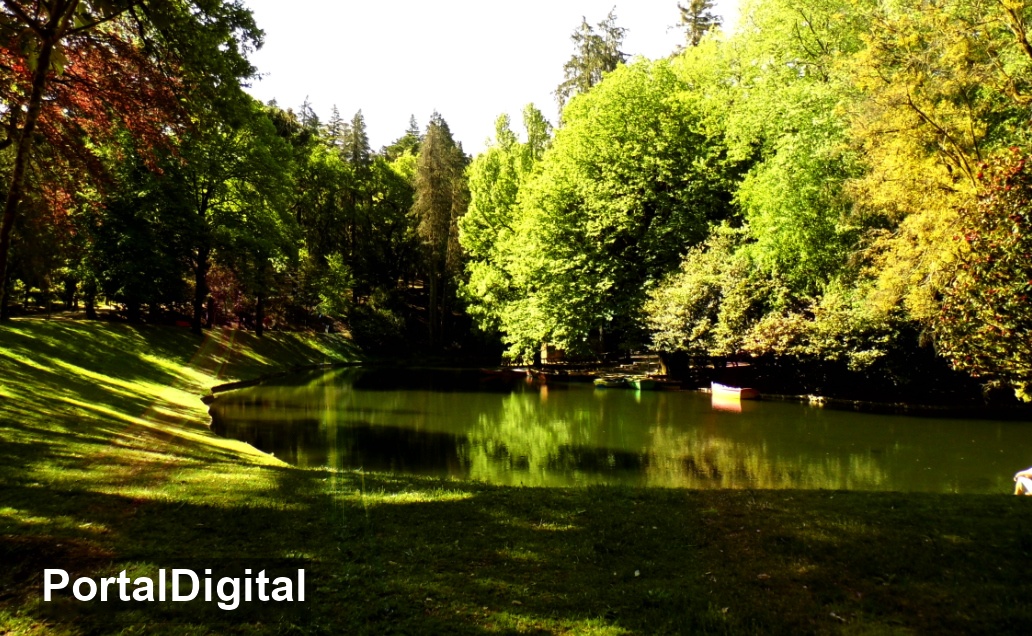
Currently, the park consists of a wooded area, several gardens, caves with reinforced concrete, a large artificial lake with boats for rent, green forest paths for strolling, sloping terrain, ramps, trails and shortcuts to explore.
This park abounds in immense vegetation rich in different species, large trees, mosses, ivy, rustic hedges, shrubby plants, viewpoints over cliffs, plant nurseries, high slopes covered with bushes, flowers, water breaking everywhere in waterfalls, and you can hear the water falling from a considerable height, in large quantities and with great noise.
On January 27, 1806, the vacant land located near the Bom Jesus Church was donated to the sanctuary.
From then on, trees were planted, clearings were formed, a large artificial lake was opened and paths were built.
Currently, the park consists of a wooded area, several gardens, caves with reinforced concrete, a large artificial lake with boats for rent, green forest paths for strolling, sloping terrain, ramps, trails and shortcuts to explore.
This park abounds in immense vegetation rich in different species, large trees, mosses, ivy, rustic hedges, shrubby plants, viewpoints over cliffs, plant nurseries, high slopes covered with bushes, flowers, water breaking everywhere in waterfalls, and you can hear the water falling from a considerable height, in large quantities and with great noise.
Caves in Bom Jesus
In Bom Jesus we find several caves: the most famous is located next to the basilica and is made up of a vault of coarse stones, built in the early years of the 20th century, designed by Ernest Korrodi.
This cave was started in 1902 and was built by Martins José Branco, from Porto.
This vaulted cave with a small lagoon, lined with aquatic plants, the water that gushes out is subjected to the effects of the sun, producing an effect similar to a volcanic eruption, where bubbles of boiling water can be seen in the lake.
The inauguration of the cave began on August 9, 1903, and it is located on a platform above the church, with a large garden space forming several grass beds, small bushes, above an octagonal viewpoint built in cork and through winding stairs you can access the top.
This cave was started in 1902 and was built by Martins José Branco, from Porto.
This vaulted cave with a small lagoon, lined with aquatic plants, the water that gushes out is subjected to the effects of the sun, producing an effect similar to a volcanic eruption, where bubbles of boiling water can be seen in the lake.
The inauguration of the cave began on August 9, 1903, and it is located on a platform above the church, with a large garden space forming several grass beds, small bushes, above an octagonal viewpoint built in cork and through winding stairs you can access the top.
Artificial lake (the largest in Bom Jesus with boats for rent)
In this artificial lake you can take a boat ride enjoying the landscape.
This space is made up of large, centuries-old trees, oaks, pine trees, rich vegetation, paths for walking, rustic bridges, tennis courts, cafes, fountains, stone benches, and listening to birdsong.
This space is made up of large, centuries-old trees, oaks, pine trees, rich vegetation, paths for walking, rustic bridges, tennis courts, cafes, fountains, stone benches, and listening to birdsong.
Figuration of Moses (Parque do Bom Jesus)
The sculpture of Moses is located on a cliff next to the bandstand and the park's lake, protected by a balcony decorated with a long vine.
It appears to represent Moses holding a rod in his left hand, the right pointing towards the abundant water, alluding to the miracle of causing the refreshing liquid to sprout from the rock to satisfy the thirsty Israelites.
It appears to represent Moses holding a rod in his left hand, the right pointing towards the abundant water, alluding to the miracle of causing the refreshing liquid to sprout from the rock to satisfy the thirsty Israelites.
Casa do Fresco or Gruta Barroca (Parque do Bom Jesus)
This fountain is located in one of the park's avenues, behind the temple, it was built in 1751 and brought to Bom Jesus in 1919 with designs by André Soares.
This cave is characterized by an exuberant decoration, asymmetrical shells planted in the ground affirming the existence of the Rococo style, a canopy-shaped roof, with floral motifs and shells covering the entire surface of the columns, cornice and roof.
Inside there is an allegorized fountain and the statue of Hercules, a figure of medium height, with his right arm raised, on the horse of a hydra that shoots water from his mouth and ears.
Hercules symbolizes physical strength, bravery, a great warrior, but he also used trickery, and by destroying several dangerous monsters he ascended to the kingdoms of Mount Olympus, where he received a welcome from the gods.
Hercules symbolizes the victory and weaknesses of the human soul, that is, the war between good and evil that represents the symbol of all sins.
This cave is characterized by an exuberant decoration, asymmetrical shells planted in the ground affirming the existence of the Rococo style, a canopy-shaped roof, with floral motifs and shells covering the entire surface of the columns, cornice and roof.
Inside there is an allegorized fountain and the statue of Hercules, a figure of medium height, with his right arm raised, on the horse of a hydra that shoots water from his mouth and ears.
Hercules symbolizes physical strength, bravery, a great warrior, but he also used trickery, and by destroying several dangerous monsters he ascended to the kingdoms of Mount Olympus, where he received a welcome from the gods.
Hercules symbolizes the victory and weaknesses of the human soul, that is, the war between good and evil that represents the symbol of all sins.
Bandstands in Bom Jesus
In the Bom Jesus do Monte Sanctuary we can find 3 bandstands in different locations: the first bandstand is located above Ernest Korrodi's cave, on May 23, 1912 an iron frame was lifted to build this bandstand also known as arbor, its frames imitate wood, it has an octagonal shape, and on the floor a compass rose with the date January 2, 1914.
The second bandstand is located in front of Casa das Estampas, on the temple's esplanade, it was built in granite, at the end of the 1920s, and served as a stage for the annual Holy Spirit festivals.
The third simplest bandstand and octagonal shape, is located near the lake in a more sheltered location, in its construction wood and metal painted red were used.
The second bandstand is located in front of Casa das Estampas, on the temple's esplanade, it was built in granite, at the end of the 1920s, and served as a stage for the annual Holy Spirit festivals.
The third simplest bandstand and octagonal shape, is located near the lake in a more sheltered location, in its construction wood and metal painted red were used.
Chapel of Anointing or Tears in Bom Jesus (16th Chapel of the Stairs or Via Sacra)
This chapel is located between the Hospedaria yard and Largo dos Evangelistas, and is located on a path of trees planted in a row among the trees next to Parque do Bom Jesus.
The Chapel of the Deposition in the Tomb or Unção das Lágrimas is a construction from the time of D. Rodrigo Moura Teles with a hexagonal plan.
Inside we can see the figure of the sacrosanct corpse stretched out on a sheet being anointed and shrouded, and the disciples Joseph of Arimathea and Nicodemus hold it with their hands.
The figure of Mary Most Holy contemplating her divine son in deep bitterness, Mary Cleopas and Veronica, Mary Salome, Magdalene kneeling weeping profusely.
Behind the Blessed Virgin, Saint John the Evangelist, and four other men in attitudes of astonishment and terror, the Roman centurion with a helmet and spear in his hand.
The set of 14 images was provided by Father Silvestre de Campos and executed by António Monteiro.
Outside the Chapel we can see the following inscription translated as: “they laid him in the tomb”
The Chapel of the Deposition in the Tomb or Unção das Lágrimas is a construction from the time of D. Rodrigo Moura Teles with a hexagonal plan.
Inside we can see the figure of the sacrosanct corpse stretched out on a sheet being anointed and shrouded, and the disciples Joseph of Arimathea and Nicodemus hold it with their hands.
The figure of Mary Most Holy contemplating her divine son in deep bitterness, Mary Cleopas and Veronica, Mary Salome, Magdalene kneeling weeping profusely.
Behind the Blessed Virgin, Saint John the Evangelist, and four other men in attitudes of astonishment and terror, the Roman centurion with a helmet and spear in his hand.
The set of 14 images was provided by Father Silvestre de Campos and executed by António Monteiro.
Outside the Chapel we can see the following inscription translated as: “they laid him in the tomb”
Chapel of the Resurrection (seventeenth Chapel of the Stairs or Via Sacra)
This small chapel is located next to a boulevard, on a path where there are trees planted in rows near Parque do Bom Jesus.
The Chapel of the Resurrection has a square shape, has a cave-shaped tomb, where six Jewish soldiers appear, the image of the resurrected Jesus elevated above the tomb.
Outside the Chapel, at the top of the entrance we can see the following inscription translated as: “he is risen, as he said”.
The Chapel of the Resurrection has a square shape, has a cave-shaped tomb, where six Jewish soldiers appear, the image of the resurrected Jesus elevated above the tomb.
Outside the Chapel, at the top of the entrance we can see the following inscription translated as: “he is risen, as he said”.